

Smart Polymers Market Poised for Strong Growth at a 19.4% CAGR Through 2035
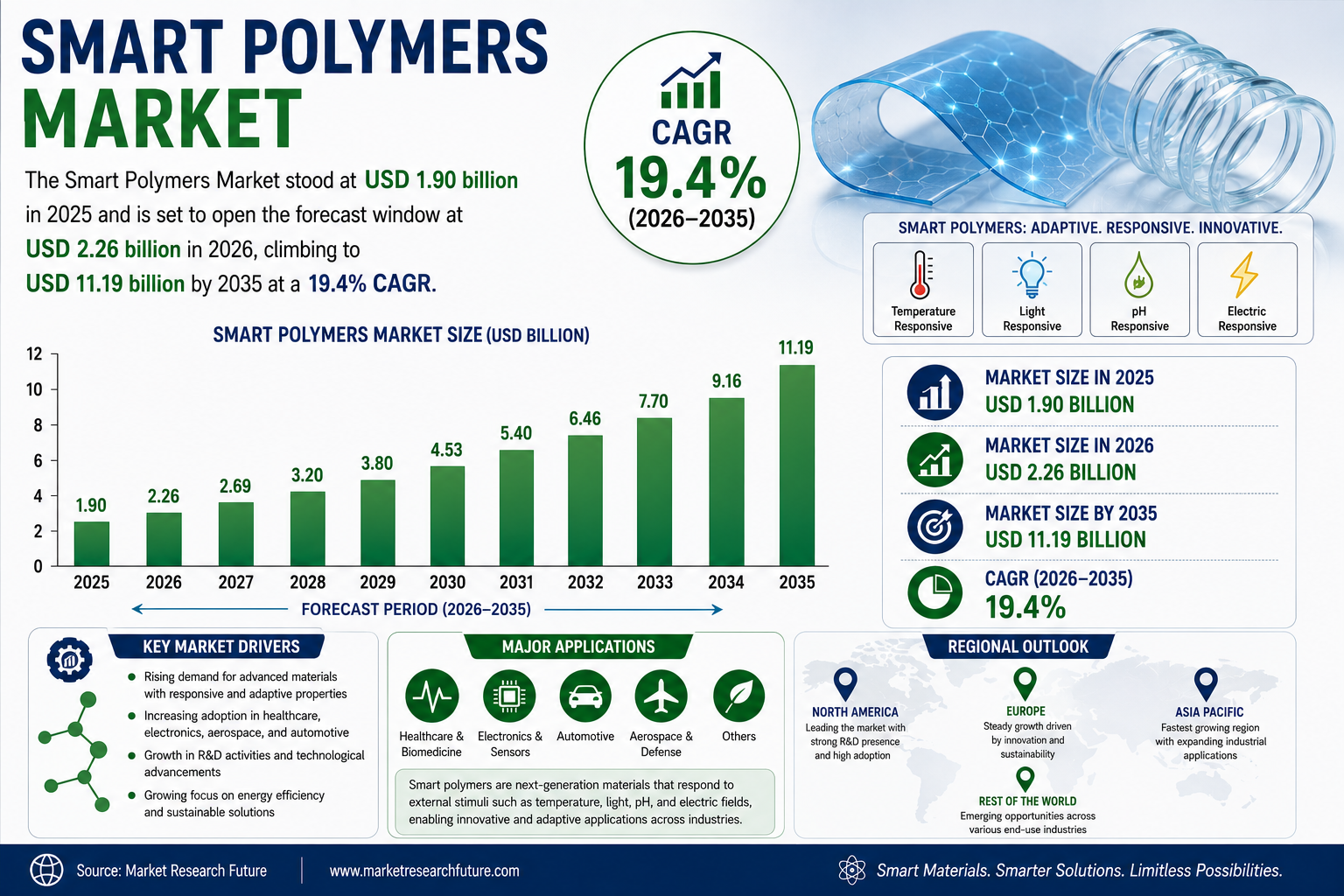
Smart Polymers Market
The global smart polymers market is experiencing a period of significant growth, driven by the materials' unique ability to respond to environmental stimuli. These "intelligent" materials are revolutionizing industries from healthcare to automotive by changing their properties in response to factors like temperature, pH, light, or electric fields . The market, valued at approximately $1.90 billion in 2025, is projected to grow substantially, with some estimates suggesting it could reach $11.19 billion by 2035, exhibiting a remarkable compound annual growth rate (CAGR) of around 19.4% . This article delves into the key drivers, market segmentation, regional dynamics, and future outlook of this dynamic and innovative sector.
What Are Smart Polymers?
Smart polymers, also known as stimuli-responsive polymers, are materials that undergo significant, reversible physical or chemical changes in response to small external environmental variations. These changes can manifest in various forms, such as alterations in shape, volume, color, or solubility . The stimuli they respond to are diverse and include:
Physical Stimuli: Temperature, light, electric or magnetic fields, and mechanical stress.
Chemical Stimuli: pH level, ionic strength, or the presence of specific chemical agents .
Biological Stimuli: Enzymes, glucose, or other biomolecules .
This versatility makes them invaluable for a wide range of advanced applications across multiple sectors.
Get Sample @ https://www.marketresearchfuture.com/sample_request/4719
Key Market Drivers
The robust growth of the smart polymers market is fueled by several key factors:
1. Expanding Healthcare and Biomedical Applications
The biomedical and biotechnology sector is the largest and fastest-growing application area for smart polymers, driven by their biocompatibility and ability to mimic biological processes . Their use is pivotal in:
Drug Delivery: Creating targeted drug delivery systems that release medication at specific sites and times .
Tissue Engineering: Serving as scaffolds for cell growth and tissue regeneration .
Medical Devices: Developing advanced medical devices, biosensors, and smart actuators .
2. Growing Adoption in the Automotive and Aerospace Industries
Smart polymers are increasingly used in the automotive and aerospace sectors to enhance performance, safety, and durability.
Self-Healing Materials: They are employed to create self-healing coatings and components that can repair minor damage autonomously, improving longevity and reducing maintenance costs.
Lightweighting: Their use in shape-memory dashboards, actuators, and sensors helps reduce vehicle weight, contributing to improved fuel efficiency .
3. Rise in Demand for Smart Textiles and Electronics
The demand for advanced functionality is driving innovation in textiles and electronics .
Smart Textiles: These polymers are integrated into fabrics to create color-changing designs, self-healing monitoring systems, and protection against harsh environments .
Flexible Electronics: Their use in flexible and wearable electronics, sensors, and actuators is a major growth area .
Buy Now @ https://www.marketresearchfuture.com/checkout?currency=one_user-USD&report_id=4719
Market Segmentation and Key Product Types
The smart polymers market can be segmented by type, stimulus, and application. Key product types include:
Shape Memory Polymers (SMPs): These polymers can "remember" a permanent shape and return to it from a temporary deformed state upon exposure to a stimulus like heat or light .
Self-Healing Polymers: As mentioned, these materials can repair damage autonomously, extending the lifespan of products.
Electroactive Polymers (EAPs): These change shape or size in response to an electric field, making them ideal for actuators, sensors, and haptic feedback systems .
Stimuli-Responsive Hydrogels: These are three-dimensional polymer networks capable of absorbing large amounts of water and swelling or shrinking in response to external stimuli, widely used in biomedical applications.
Regional Market Insights
North America: The Current Market Leader
North America holds the largest share of the global smart polymers market, driven by strong investment in advanced materials research, a well-established healthcare industry, and significant government funding from organizations like the National Science Foundation (NSF) and the National Institutes of Health (NIH) . The presence of major research universities and biotechnology companies fuels continuous innovation.
Asia-Pacific: The Fastest Growing Market
The Asia-Pacific region is anticipated to exhibit the highest CAGR during the forecast period . This growth is attributed to rapidly expanding biomedical research, increasing healthcare investment, and a growing manufacturing base for advanced materials in countries like China, Japan, South Korea, and India . Government initiatives promoting advanced materials and biotechnology research are accelerating adoption in the region .
Challenges and Restraints
Despite its promising outlook, the smart polymers market faces challenges, primarily concerning the high cost of production and the complexity of manufacturing processes. Additionally, increasing government regulations related to the use of polymer-based products and their environmental impact may pose a restraint. The manufacturing process can emit toxic gases, leading to stricter rules and a push for more sustainable, green chemical-based alternatives.
Competitive Landscape
The smart polymers market is competitive, with several key global players driving innovation and market share. Major companies include:
BASF SE
Dow Inc.
Covestro AG
Arkema S.A.
Evonik Industries AG
DuPont de Nemours, Inc.
Lubrizol Corporation
These industry leaders are continuously investing in research and development, strategic partnerships, and new product launches to maintain their positions and address the evolving needs of end-user industries .
Read More @ https://www.marketresearchfuture.com/reports/smart-polymers-market-4719
Future Outlook and Key Trends
The future of the smart polymers market is bright, with several key trends shaping its trajectory:
Sustainability and Biodegradable Materials: A growing emphasis on sustainable and biodegradable polymers is fostering innovation in eco-friendly smart materials.
Integration with 4D Printing: The convergence of smart polymers and 3D printing is opening new frontiers in 4D printing, where printed objects can change shape over time in response to stimuli.
Personalized Medicine: The ability of smart polymers to deliver drugs in a controlled and targeted manner makes them central to the advancement of precision and personalized medicine.
Expansion into New Sectors: Beyond the traditional markets, smart polymers are finding new applications in sectors like nuclear energy, construction, and responsive packaging.
Browse More Reports:
Quaternary Ammonium Compounds Market https://www.marketresearchfuture.com/reports/quaternary-ammonium-compounds-market-12081
Aramid Fiber Market https://www.marketresearchfuture.com/reports/aramid-fiber-market-5868
Wood Plastic Composites Market https://www.marketresearchfuture.com/reports/wood-plastic-composites-market-8311
carbon offsets market https://www.marketresearchfuture.com/reports/carbon-offsets-market-23139
plastic lumber market https://www.marketresearchfuture.com/reports/plastic-lumber-market-28854
Market Research Future
Market Research Future
+1 855-661-4441
email us here
Legal Disclaimer:
EIN Presswire provides this news content "as is" without warranty of any kind. We do not accept any responsibility or liability for the accuracy, content, images, videos, licenses, completeness, legality, or reliability of the information contained in this article. If you have any complaints or copyright issues related to this article, kindly contact the author above.
